Transform Your AI from Generic to Genius: The RAG Revolution
Imagine asking your AI assistant about your company's Q3 sales figures, and instead of getting a vague response or outdated information, it pulls the exact data from your latest reports and gives you precise, actionable insights. That's the power of Retrieval Augmented Generation (RAG)—and it's revolutionizing how businesses leverage artificial intelligence.
What Is RAG and Why Should You Care?
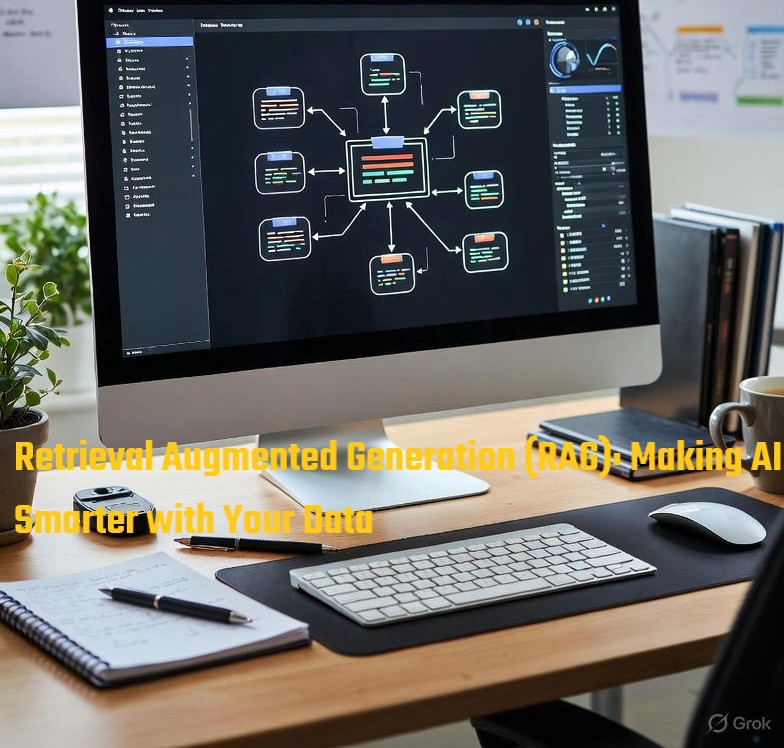
Retrieval Augmented Generation is a cutting-edge AI technique that combines the conversational abilities of large language models (LLMs) with the precision of information retrieval systems. Think of it as giving your AI a photographic memory of your specific data, documents, and knowledge base.
Traditional AI models are trained on massive datasets but have a knowledge cutoff date. They don't know about your proprietary information, recent company updates, or specialized industry knowledge. RAG solves this fundamental limitation by connecting AI to your real-time data sources.
How Does RAG Work? The Three-Step Magic
Step 1: Retrieval (Finding the Right Information)
When you ask a question, the RAG system doesn't immediately generate an answer. Instead, it searches through your connected databases, documents, wikis, or any data source you've provided. Using sophisticated search algorithms and vector embeddings, it identifies the most relevant pieces of information related to your query.
Step 2: Augmentation (Context Enhancement)
The retrieved information is then packaged and presented to the language model as context. This is like giving the AI a cheat sheet with exactly the information it needs to answer your specific question accurately.
Step 3: Generation (Crafting the Perfect Response)
With this context in hand, the AI generates a response that's grounded in your actual data rather than generic training knowledge. The result? Answers that are accurate, current, and tailored to your specific needs.
Real-World Applications: RAG in Action
Customer Support Excellence
Companies are deploying RAG-powered chatbots that can instantly access product manuals, troubleshooting guides, and customer history to provide accurate, personalized support 24/7. No more frustrating "I don't have that information" responses.
Enterprise Knowledge Management
Organizations with vast documentation—from HR policies to technical specifications—use RAG to make institutional knowledge instantly accessible. Employees get precise answers pulled from the exact documents they need, complete with source citations.
Healthcare and Medical Research
Medical professionals leverage RAG to query vast databases of research papers, patient records, and treatment protocols, getting evidence-based recommendations grounded in the latest medical literature.
Legal and Compliance
Law firms and compliance teams use RAG to search through contracts, case law, and regulatory documents, extracting relevant precedents and clauses in seconds rather than hours.
The Business Benefits: Why RAG Is a Game-Changer
Accuracy Over Hallucination: Traditional AI models sometimes "hallucinate" or make up information when they don't know the answer. RAG systems retrieve actual data, drastically reducing false information.
Always Current: Your AI assistant knows about yesterday's meeting notes, this morning's price changes, or last week's policy update because it's connected directly to your living documents.
Source Transparency: RAG systems can cite their sources, showing you exactly which document or database entry informed their response. This builds trust and enables verification.
Cost Efficiency: Instead of fine-tuning massive models on your proprietary data (expensive and time-consuming), RAG lets you leverage existing powerful models with your data on-demand.
Privacy and Security: Your sensitive data stays within your infrastructure. RAG retrieves and uses it contextually without needing to upload it for model training.
Building Your RAG System: What You Need to Know
Choose Your Knowledge Base
Start by identifying what data sources your AI should access—company wikis, databases, PDFs, spreadsheets, or cloud storage. The broader and more organized your knowledge base, the more powerful your RAG system becomes.
Select the Right Vector Database
Modern RAG systems use vector databases like Pinecone, Weaviate, or Chroma to store and search document embeddings efficiently. These databases enable semantic search, finding information based on meaning rather than just keywords.
Integrate with Your LLM
Popular language models like GPT-4, Claude, or open-source alternatives like Llama 2 can be integrated with your retrieval system. Many platforms now offer RAG-as-a-service, simplifying implementation.
Optimize Your Retrieval Strategy
Not all retrieved information is equally useful. Fine-tune your system to retrieve the right amount of context—too little and answers lack detail, too much and the AI gets overwhelmed with irrelevant information.
Common Challenges and How to Overcome Them
Data Quality Issues: RAG is only as good as your data. Outdated, inaccurate, or poorly organized information will lead to poor responses. Invest in data governance and regular updates.
Retrieval Relevance: Sometimes the system retrieves irrelevant documents. Improve this by using better search algorithms, refining your embeddings, or implementing hybrid search approaches that combine semantic and keyword search.
Response Latency: Real-time retrieval adds processing time. Optimize by using efficient vector databases, caching common queries, and implementing smart pre-filtering.
Context Window Limitations: Language models have token limits. If your retrieved context is too large, it won't fit. Address this through intelligent chunking and prioritizing the most relevant passages.
The Future of RAG: What's Next?
The RAG landscape is evolving rapidly. Emerging trends include multi-modal RAG (incorporating images, videos, and audio), agentic RAG systems that can reason about which sources to query, and hybrid approaches that combine RAG with fine-tuning for optimal performance.
We're also seeing RAG being integrated with graph databases to understand relationships between entities, and with real-time data streams for up-to-the-second information retrieval.
Getting Started: Your RAG Implementation Roadmap
Month 1: Audit your data sources and identify high-value use cases. Start with a single, well-defined problem like internal documentation search or customer support.
Month 2: Set up your vector database and create embeddings for your documents. Experiment with different chunking strategies to find what works best.
Month 3: Integrate with your chosen LLM and begin testing. Gather feedback from a small user group and iterate on retrieval quality.
Month 4+: Expand to additional use cases, optimize performance, and scale across your organization.
Key Takeaways: Making AI Work for You
Retrieval Augmented Generation represents a paradigm shift in how we interact with AI. Instead of treating language models as static knowledge bases with fixed information, RAG transforms them into dynamic systems that grow and adapt with your organization's evolving knowledge.
The businesses that thrive in the AI era won't be those with the biggest models, but those that best connect AI to their proprietary data and expertise. RAG makes this connection possible, practical, and powerful.
Whether you're a startup looking to punch above your weight or an enterprise seeking to unlock decades of institutional knowledge, RAG offers a path to AI that's not just smart—it's your kind of smart.
Ready to Implement RAG?
The technology is mature, the tools are accessible, and the competitive advantages are real. The question isn't whether to implement RAG, but how quickly you can get started. Your data is waiting to make your AI exponentially more valuable.
Start your RAG journey today and transform how your organization leverages artificial intelligence.