The quantum computing revolution is no longer a distant dream confined to theoretical physics laboratories. After decades of incremental progress, the field is experiencing a remarkable acceleration, with researchers and technology companies achieving breakthroughs that bring practical quantum applications closer to reality than ever before. As we move through 2025, the quantum computing landscape is transforming from a realm of experimental curiosity into a domain where tangible solutions to real-world problems are beginning to emerge.
The Current State of Quantum Computing
Quantum computing leverages the peculiar properties of quantum mechanics—superposition, entanglement, and interference—to process information in fundamentally different ways than classical computers. While traditional computers use bits that exist as either 0 or 1, quantum computers use quantum bits, or qubits, which can exist in multiple states simultaneously. This property enables quantum computers to explore vast solution spaces exponentially faster than their classical counterparts for certain types of problems.
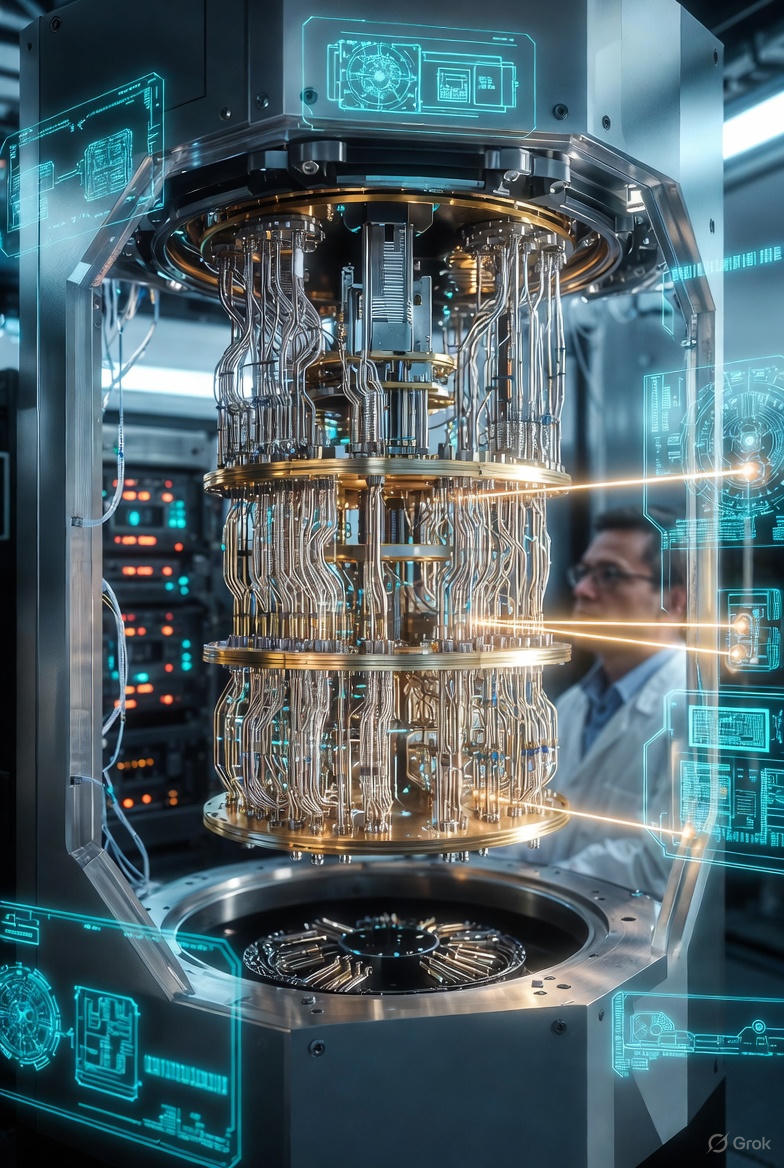
The journey toward practical quantum computing has been marked by significant technical challenges. Qubits are notoriously fragile, requiring isolation from environmental interference that can cause decoherence—the loss of quantum properties that makes computation possible. Maintaining qubits at temperatures near absolute zero, managing error rates, and scaling systems to include enough qubits for meaningful calculations have been persistent obstacles. However, recent breakthroughs are systematically addressing these challenges.
Error Correction: The Holy Grail Achieved
One of the most significant recent advances in quantum computing is the demonstration of practical quantum error correction. Error correction has long been considered the holy grail of quantum computing because it addresses the fundamental problem of qubit instability. In late 2024 and early 2025, multiple research teams announced breakthroughs in error correction that finally achieved "below threshold" performance—meaning that adding more qubits to an error-corrected system actually reduces errors rather than compounding them.
Google's Quantum AI team made headlines with demonstrations showing that their surface code implementation could suppress errors exponentially as they increased the code distance. This achievement represents a critical inflection point: it proves that quantum computers can, in principle, be scaled to arbitrary sizes while maintaining computational fidelity. Similar advances from IBM, Microsoft, and academic institutions have validated multiple approaches to error correction, suggesting that the path to fault-tolerant quantum computing is now clearly visible.
These error correction breakthroughs don't just represent theoretical victories—they directly impact the timeline for practical applications. With effective error correction, quantum computers can run longer, more complex algorithms without succumbing to noise and decoherence. This capability is essential for tackling real-world problems that require sustained quantum computation over many operational steps.
Increasing Qubit Counts and Quality
The race to build larger quantum processors continues to accelerate. IBM has been particularly aggressive in expanding its quantum hardware roadmap, with systems now regularly exceeding 100 qubits and plans for systems with over 1,000 qubits progressing on schedule. However, the quantum computing community has learned that raw qubit count is only part of the equation—qubit quality, connectivity, and coherence times are equally crucial.
Recent advances have focused on improving these qualitative metrics. Superconducting qubit systems are achieving longer coherence times, with some implementations maintaining quantum states for milliseconds—an eternity in quantum computing terms. Trapped-ion systems, championed by companies like IonQ and Quantinuum, are demonstrating exceptionally high-fidelity gate operations, with error rates dropping below the stringent thresholds required for practical error correction.
Photonic quantum computing, which uses light particles as qubits, is emerging as a promising alternative architecture. Companies like Xanadu and PsiQuantum are developing photonic systems that could potentially operate at room temperature, eliminating the need for expensive cryogenic cooling systems. These diverse approaches to building quantum computers suggest that the field is maturing, with multiple viable pathways toward practical systems.
Industry Applications Beginning to Emerge
The pharmaceutical and materials science industries are among the first to benefit from quantum computing capabilities. Drug discovery, which traditionally involves screening millions of molecular candidates through expensive and time-consuming laboratory processes, is being revolutionized by quantum simulation. Quantum computers can model molecular interactions with unprecedented accuracy, potentially reducing the time and cost required to develop new medications.
Several pharmaceutical companies have established quantum computing partnerships specifically targeting drug discovery workflows. Early results are promising: quantum algorithms have successfully simulated complex molecular systems that would be intractable for classical computers, identifying promising drug candidates and predicting their properties with impressive accuracy. While these applications are still in relatively early stages, they demonstrate that quantum computing is beginning to deliver practical value in high-stakes industrial contexts.
Financial services represent another sector where quantum computing is approaching practical utility. Portfolio optimization, risk analysis, and fraud detection are computational problems well-suited to quantum approaches. Major financial institutions, including JPMorgan Chase, Goldman Sachs, and others, have invested heavily in quantum computing research and are developing quantum algorithms tailored to financial applications. Some institutions have reported quantum advantage in specific financial modeling scenarios, though widespread deployment remains on the horizon.
Optimization and Machine Learning
Optimization problems—finding the best solution among countless possibilities—are ubiquitous across industries, from logistics and supply chain management to telecommunications network design and energy grid optimization. Quantum computers are particularly well-suited to certain classes of optimization problems, and recent breakthroughs are demonstrating practical advantages.
Volkswagen has experimented with quantum algorithms for traffic flow optimization, attempting to reduce congestion in major cities. Airbus is exploring quantum optimization for aircraft loading and flight path planning. These applications may not require fully fault-tolerant quantum computers, making them attractive targets for near-term quantum systems often called NISQ (Noisy Intermediate-Scale Quantum) devices.
Quantum machine learning represents a fascinating frontier where quantum computing intersects with artificial intelligence. Researchers are developing quantum algorithms that could accelerate certain machine learning tasks, potentially enabling new approaches to pattern recognition, classification, and generative modeling. While quantum machine learning is still largely experimental, the rapid progress in both quantum computing and classical AI creates exciting possibilities for hybrid systems that leverage the strengths of both paradigms.
Cryptography and Security Implications
Quantum computing's implications for cybersecurity are profound and urgent. Sufficiently powerful quantum computers will be able to break many of the encryption schemes that currently protect everything from online banking to government communications. This threat has spurred the development of post-quantum cryptography—encryption methods designed to resist quantum attacks.
The National Institute of Standards and Technology (NIST) has been leading efforts to standardize post-quantum cryptographic algorithms, with several candidates selected for standardization in 2024. Organizations are beginning the complex process of transitioning to quantum-resistant encryption, a task complicated by the need to protect not only current communications but also archived data that could be decrypted by future quantum computers.
Paradoxically, quantum technology also offers solutions to the security problems it creates. Quantum key distribution (QKD) uses the principles of quantum mechanics to create theoretically unbreakable encryption keys. Several countries, particularly China, have invested heavily in quantum communication networks based on QKD. While practical challenges remain, quantum-secured communication networks are expanding from laboratory demonstrations to real-world deployments.
Cloud Quantum Computing
The democratization of quantum computing through cloud access is accelerating research and application development. IBM Quantum, Amazon Braket, Microsoft Azure Quantum, and other platforms allow researchers, developers, and businesses to access quantum computers without building their own hardware. This cloud-based approach mirrors the early development of classical computing and is essential for building the quantum ecosystem.
Cloud quantum platforms are increasingly sophisticated, offering not just hardware access but comprehensive development environments, simulators, and educational resources. These platforms enable a growing community of quantum developers to gain hands-on experience with real quantum hardware, experiment with quantum algorithms, and develop practical applications. The availability of cloud quantum computing is training a new generation of quantum programmers and accelerating the discovery of practical quantum applications.
Challenges That Remain
Despite remarkable progress, significant challenges remain before quantum computing achieves its full potential. Scaling quantum systems to the millions of qubits likely required for the most ambitious applications remains an enormous engineering challenge. Each qubit requires precise control and measurement capabilities, and interconnecting large numbers of qubits while maintaining coherence and minimizing crosstalk grows increasingly complex.
Developing quantum algorithms that provide genuine advantages over classical approaches for practical problems requires ongoing research. For many applications, classical computers continue to improve through better algorithms and more powerful hardware, meaning quantum computers must hit a moving target. Identifying the "killer apps" where quantum computers provide indisputable advantages remains an active area of investigation.
The quantum computing workforce shortage poses another challenge. Building, operating, and programming quantum computers requires specialized expertise spanning quantum physics, computer science, electrical engineering, and domain-specific knowledge. Educational institutions are expanding quantum computing curricula, but developing the workforce needed to support a mature quantum computing industry will take time.
Looking Forward
The trajectory of quantum computing suggests that the 2020s will be remembered as the decade when quantum computing transitioned from laboratory curiosity to practical technology. While we may not yet have quantum computers on every desktop, specialized quantum processors are increasingly likely to be integrated into computational workflows for specific high-value applications.
The next few years will likely see continued progress in error correction, with the first truly fault-tolerant quantum computers potentially emerging before 2030. Hybrid classical-quantum systems, where quantum processors handle specific computational tasks while classical computers manage overall workflows, will probably become more common. As quantum hardware improves and quantum algorithms mature, the range of practical applications will expand beyond early adopters in pharmaceuticals, finance, and materials science to encompass broader industries.
Quantum computing's approach to practical applications represents one of the most exciting technological developments of our time. While significant challenges remain, the breakthroughs achieved in recent years have transformed quantum computing from a speculative technology into an emerging reality with the potential to reshape how we solve some of humanity's most complex problems.