Introduction: The Dawn of Self-Directed AI
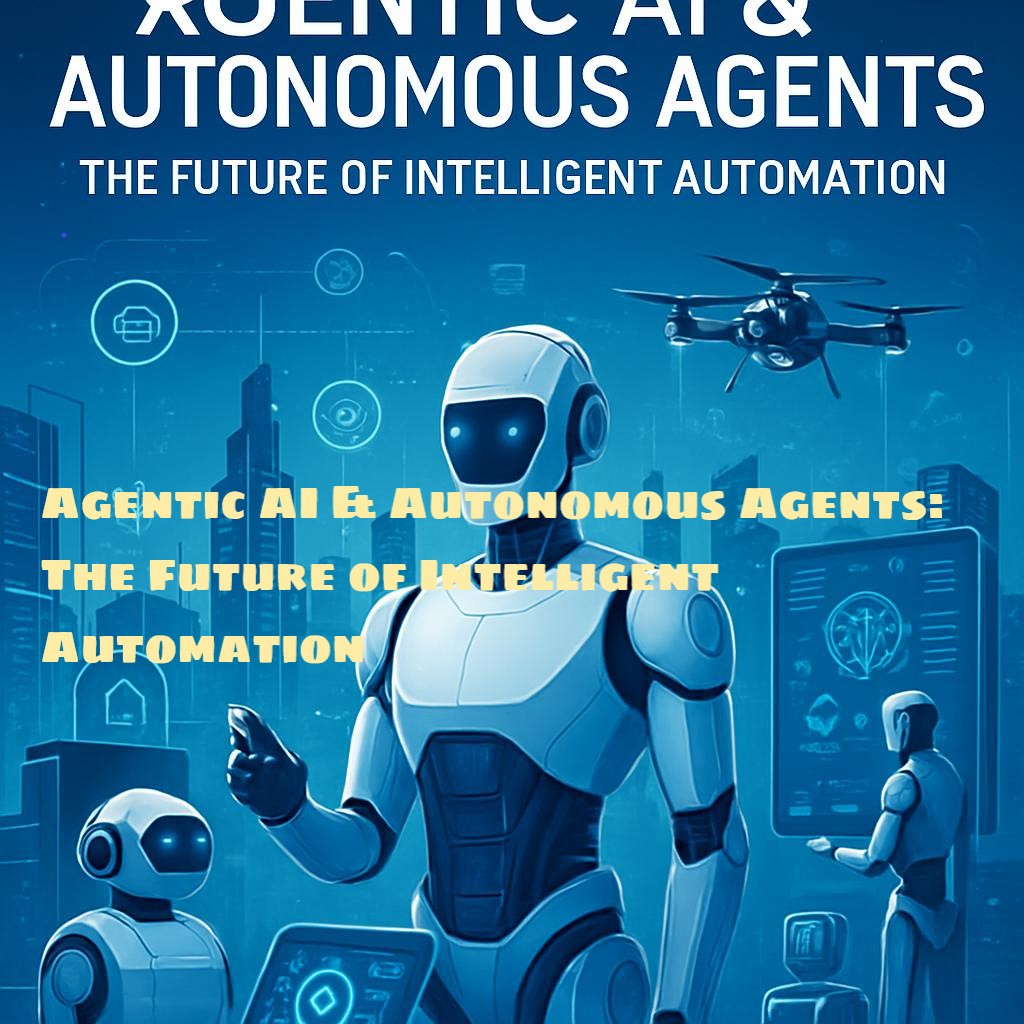
Imagine an AI that doesn't just answer your questions but actually completes entire projects for you. An intelligent system that breaks down complex goals, makes decisions independently, and adapts its approach based on real-time feedback. This isn't science fiction—it's the emerging reality of agentic AI and autonomous agents, technologies that are fundamentally reshaping how we interact with artificial intelligence.
While traditional AI systems have been reactive, requiring constant human prompts and guidance, agentic AI represents a paradigm shift toward proactive, goal-oriented intelligence. These systems can plan, execute, and refine their approaches with minimal human intervention, making them one of the most transformative developments in modern technology.
What is Agentic AI?
Agentic AI refers to artificial intelligence systems that possess agency—the ability to act independently toward specific goals. Unlike conventional AI that simply processes inputs and generates outputs, agentic AI can set sub-goals, develop strategies, make autonomous decisions, and take actions to achieve defined objectives.
Think of the difference this way: a traditional AI chatbot waits for your questions and responds. An agentic AI system, given a goal like "research competitors and create a market analysis report," will independently search for information, evaluate sources, synthesize findings, structure a report, and potentially even schedule a meeting to present its results.
Key Characteristics of Agentic AI
Autonomy: These systems operate independently once given an objective, making decisions without requiring approval for every step.
Goal-Oriented Behavior: Rather than responding to isolated prompts, agentic AI works toward achieving specific outcomes, often breaking complex goals into manageable sub-tasks.
Adaptive Learning: Autonomous agents adjust their strategies based on results, learning from successes and failures to improve future performance.
Environmental Awareness: These systems perceive and respond to their operating environment, whether digital ecosystems, physical spaces through robotics, or hybrid domains.
Tool Use: Advanced agentic AI can leverage external tools, APIs, databases, and software applications to accomplish tasks, extending their capabilities far beyond their core programming.
Understanding Autonomous Agents
Autonomous agents are the practical implementation of agentic AI—self-governing systems designed to perceive their environment, make decisions, and take actions to achieve specific goals. These agents operate across a spectrum of autonomy, from semi-autonomous systems requiring occasional human oversight to fully autonomous agents that function entirely independently.
The Architecture of Autonomous Agents
Modern autonomous agents typically consist of several integrated components:
Perception Module: Gathers information from the environment through sensors, data feeds, or digital interfaces, providing the agent with situational awareness.
Decision Engine: Processes perceived information using advanced algorithms, machine learning models, and reasoning frameworks to determine optimal actions.
Action Interface: Executes decisions through various means—sending commands, manipulating digital interfaces, controlling physical actuators, or communicating with other systems.
Memory Systems: Stores experiences, learned patterns, and contextual information, enabling the agent to improve over time and maintain consistency across interactions.
Feedback Loop: Continuously evaluates action outcomes, allowing the agent to refine its approach and adapt to changing circumstances.
Real-World Applications Transforming Industries
Business and Enterprise Automation
Agentic AI is revolutionizing business operations by handling complex workflows that previously required significant human coordination. Autonomous agents now manage customer service escalations, automatically prioritizing issues, gathering relevant information, and even resolving problems without human intervention.
In sales and marketing, these systems conduct prospect research, personalize outreach campaigns, schedule follow-ups, and analyze engagement metrics—all while adapting strategies based on response patterns. Financial departments deploy autonomous agents for invoice processing, expense verification, and anomaly detection, dramatically reducing processing times while improving accuracy.
Software Development and DevOps
The software industry has embraced agentic AI through autonomous coding assistants that go far beyond simple code completion. These agents can understand project requirements, architect solutions, write code across multiple files, debug errors, optimize performance, and even write documentation—essentially functioning as tireless programming partners.
DevOps teams utilize autonomous agents for continuous monitoring, automatically detecting issues, diagnosing root causes, implementing fixes, and deploying updates with minimal human oversight. This dramatically accelerates development cycles while maintaining system reliability.
Healthcare and Medical Research
In healthcare, autonomous agents are assisting with diagnosis by analyzing patient data, medical imaging, and research literature to identify patterns and suggest treatment options. They're also revolutionizing drug discovery by autonomously designing and evaluating potential compounds, dramatically accelerating research timelines.
Administrative autonomous agents handle appointment scheduling, insurance verification, and medical record management, allowing healthcare professionals to focus on patient care rather than paperwork.
Scientific Research and Discovery
Research laboratories are deploying autonomous agents to design experiments, analyze results, identify promising research directions, and even generate hypotheses for testing. These systems can work continuously, exploring vast parameter spaces and making connections that might elude human researchers constrained by time and cognitive limitations.
The Technology Behind Agentic AI
Large Language Models as Foundation
Modern agentic AI leverages large language models (LLMs) as cognitive engines, providing natural language understanding, reasoning capabilities, and knowledge synthesis. However, true agentic systems extend far beyond basic LLM capabilities by incorporating planning algorithms, tool integration frameworks, and multi-step reasoning capabilities.
Reinforcement Learning and Adaptive Behavior
Many autonomous agents employ reinforcement learning, where systems learn optimal behaviors through trial and error, receiving rewards for successful actions and penalties for failures. This enables agents to discover effective strategies even in complex, unpredictable environments.
Multi-Agent Systems
Increasingly, organizations deploy multiple specialized agents that collaborate on complex tasks. One agent might specialize in research, another in analysis, and a third in communication—working together like a coordinated team to achieve shared objectives.
Challenges and Considerations
Reliability and Error Management
Autonomous systems can make mistakes, sometimes in unexpected ways. Ensuring reliable operation requires robust error detection, graceful failure handling, and appropriate human oversight mechanisms, particularly in high-stakes applications.
Ethical and Safety Concerns
Granting AI systems greater autonomy raises important questions: How do we ensure alignment with human values? What safeguards prevent unintended consequences? Who bears responsibility when autonomous agents make harmful decisions?
Security and Control
Autonomous agents with access to systems and data create new security vulnerabilities. Protecting against malicious use, preventing unauthorized actions, and maintaining appropriate human control remain critical challenges.
Transparency and Explainability
As agents make increasingly complex decisions through multi-step reasoning, understanding why they took specific actions becomes challenging. Developing explainable agentic AI remains an active research priority.
The Future of Agentic AI
The trajectory of agentic AI points toward increasingly sophisticated, capable, and integrated autonomous systems. We're moving toward a future where AI agents serve as persistent collaborators, managing complex projects from inception to completion while adapting to our preferences and work styles.
Emerging developments include agents that maintain long-term memory and relationships, systems that seamlessly collaborate with both humans and other AI agents, and embodied autonomous agents in robotics that navigate and manipulate the physical world with increasing dexterity.
As these technologies mature, they promise to amplify human capabilities dramatically, handling routine complexity while freeing humans to focus on creative, strategic, and interpersonal work that requires uniquely human qualities.
Conclusion: Embracing the Agentic Revolution
Agentic AI and autonomous agents represent more than incremental improvements in artificial intelligence—they constitute a fundamental shift in how we conceive of and interact with intelligent systems. Rather than tools we actively operate, they're becoming collaborative partners that share our goals and work alongside us to achieve them.
The organizations, industries, and individuals who understand and effectively harness agentic AI will gain substantial advantages in productivity, innovation, and problem-solving capability. However, realizing this potential requires thoughtful implementation, appropriate safeguards, and ongoing attention to ethical considerations.
The age of agentic AI is not approaching—it's already here. The question is no longer whether these technologies will transform our world, but how quickly we can adapt to work alongside our new autonomous collaborators. Those who embrace this shift while navigating its challenges thoughtfully will be best positioned to thrive in an increasingly AI-augmented future.