Meta Title: AI Chip Wars: Nvidia, Sovereign Silicon & the Fight for AI's Future | 2025 Analysis
Meta Description: Beyond software, the real AI battle is hardware. Explore Nvidia's dominance, US-China chip wars, RISC-V disruption & why controlling silicon means controlling AI's future.
The Unseen Battlefield: AI Runs on Silicon, Not Just Code
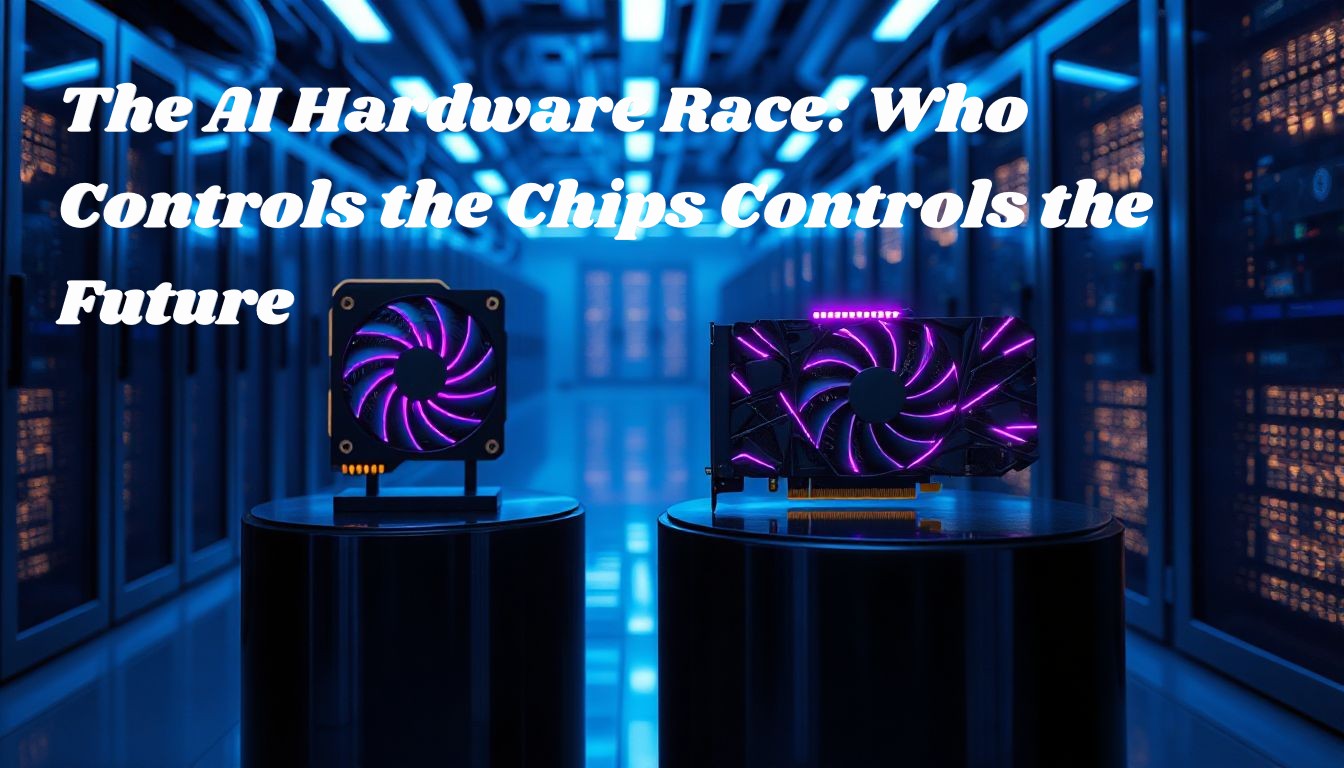
While ChatGPT and Gemini dominate headlines, a far more consequential war rages beneath the surface: the fight to control the physical engines of artificial intelligence. GPUs, TPUs, and custom silicon aren't just components—they are the strategic choke points of the AI revolution. Whoever dominates AI hardware dictates the pace, accessibility, and geopolitical balance of artificial intelligence.
Nvidia: The Undisputed King (For Now)
Nvidia’s GPUs (Graphics Processing Units) are the de facto currency of modern AI:
- Market Monopoly: >80% share in data center AI accelerators.
- CUDA Ecosystem Lock-in: Millions of developers trained on its proprietary software platform.
- Hopper & Blackwell Architectures: Unmatched performance for training massive LLMs.
- Vertical Integration: From chips (H100, B200) to full DGX supercomputers and AI factories.
But cracks are appearing:
- Sky-High Costs: Single H100 GPU: ~$30,000. Full DGX system: >$250k.
- Supply Constraints: Global shortages fuel black markets.
- Vulnerable Supply Chain: Reliance on TSMC (Taiwan) creates geopolitical risk.
Challengers Emerge: Breaking the CUDA Kingdom
1. AMD & Intel: The Traditional Titans Strike Back
- AMD MI300 Series: Competitive performance, 2.5x better memory bandwidth than H100. Adopted by Meta, Microsoft.
- Intel Gaudi 3: Claims 40% faster inference than H100 at half the cost. Key to AWS, Google Cloud.
- Strategy: Leverage open software (ROCm, OneAPI) to erode CUDA’s moat.
2. Cloud Giants Go Custom: The Hyperscaler Rebellion
- Google TPU v5: 4th-gen custom tensor processors power Gemini. Optimized for efficiency.
- AWS Trainium/Inferentia 3: Slash LLM training costs by 50% vs. GPUs.
- Microsoft Maia 100: Co-designed with OpenAI for Azure’s Copilot infrastructure.
- Why it matters: Hyperscalers control 70%+ of AI compute. Their in-house chips bypass Nvidia entirely.
3. RISC-V: The Open-Source Joker Card
- Radical Disruption: Open-source instruction set architecture (ISA) – no licensing fees.
- Momentum: Tenstorrent (Jim Keller), SiFive building RISC-V AI accelerators.
- China’s Lifeline: Alibaba, Huawei using RISC-V to bypass US export bans.
- Potential: Democratizes chip design but lags in high-end AI performance (for now).
Geopolitics of Silicon: The Fight for "AI Sovereignty"
🇺🇸 United States:
- CHIPS Act: $52B to revive domestic manufacturing (Intel, TSMC Arizona fabs).
- Export Controls: Blocking advanced AI chips (A100/H100) and equipment to China.
🇨🇳 China:
- $150B Investment: Pouring capital into SMIC, Huawei, Biren.
- Huawei Ascend 910B: Nvidia A100-level performance despite sanctions.
- Shadow Fabs: Secret semiconductor networks via Malaysia, UAE.
🇪🇺 Europe/India/Japan:
- EU Chips Act: €43B for 20% global semiconductor share by 2030.
- India’s $10B Plan: Tata building fab with Powerchip (Taiwan).
- Japan’s Rapidus: Targeting 2nm chips with IBM support.
The Future: Custom Silicon, Chiplets, and Quantum Threats
- Specialized AI Chips Explode:
- Domain-Specific ASICs: Chips optimized for healthcare (genomics), robotics, or climate modeling.
- Chiplet Revolution: Modular designs (e.g., AMD’s MI300) lowering costs and boosting yields.
- Supply Chain Resilience:
- Diversifying beyond Taiwan (TSMC): Intel Ohio, Samsung Texas, SMIC Shanghai.
- Quantum Hybridization:
- Quantum accelerators (IBM, Quantinuum) supplementing classical AI chips for specific tasks.
Who Wins? The Stakes of the Silicon War
|
Player |
Advantage |
Critical Vulnerability |
|
Nvidia |
Software dominance (CUDA) |
Geopolitics, hyperscaler defection |
|
AMD/Intel |
Manufacturing scale |
Catching up on AI performance |
|
Hyperscalers |
Control demand & infrastructure |
Limited external chip sales |
|
China |
Massive state funding |
Lagging 5+ years in process nodes |
|
RISC-V |
Openness, cost, sovereignty |
Ecosystem maturity |